


You have vacuumed the carpets, wiped the kitchen worktops and cleaned the bathroom, yet an unpleasant smell keeps returning. Perhaps it is a musty odour in the bedroom, a lingering cooking smell in the kitchen or an unexplained damp scent near the bathroom. If this sounds familiar, the problem may be hiding in places that everyday cleaning does not always reach.
A home clean can look tidy without every surface, fabric or hard-to-reach area being thoroughly clean. Odour-causing residues may remain in upholstery, mattresses, waste bins, drains, grout or areas affected by moisture. Simply spraying air freshener might mask the smell temporarily without addressing its source.
Understanding where these odours originate is the first step towards dealing with them effectively. For households looking for deep cleaning services Milton Keynes, a more thorough cleaning routine can help tackle accumulated dirt and residues that routine maintenance may leave behind.
This guide explains the common causes of persistent household smells, the areas worth checking, practical cleaning methods and when professional assistance may be appropriate.
Why Does Your Home Smell Even After Cleaning?
Everyday house cleaning is important for keeping visible dirt under control. However, different materials collect different types of residue, and some require more attention than a quick wipe or vacuum.
A kitchen worktop, for example, can look clean while grease remains around the cooker hood or behind a freestanding appliance. Similarly, a bathroom may appear fresh while soap deposits and moisture remain around tile grout, shower seals or less accessible corners.
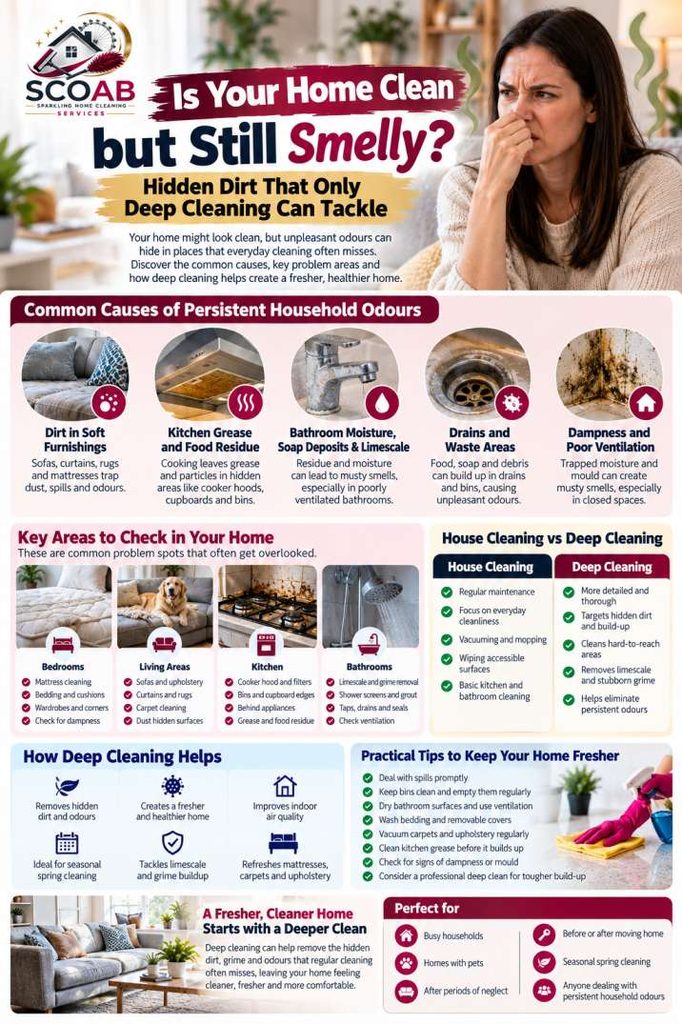
Persistent odours commonly come from a few sources.
1. Dirt and residue trapped in soft furnishings
Curtains, sofas, rugs, cushions and mattresses can collect dust, skin particles, food crumbs and other organic material. Spilled drinks, pet accidents and perspiration may also leave residues that contribute to unpleasant smells.
Vacuuming helps remove loose debris, but it may not eliminate every embedded particle or stain. Some fabrics also require specific cleaning methods to avoid damage.
What to do: Vacuum upholstery and mattress surfaces using a suitable attachment. Check the manufacturer’s care instructions before applying a cleaning solution, and allow cleaned materials to dry thoroughly.
2. Kitchen grease and food residue
Cooking produces grease, moisture and airborne particles that can settle beyond the most obvious surfaces. Residue may accumulate around splashbacks, extractor filters, bin lids, cupboard handles and the sides of appliances.
When food particles remain in a waste bin or an overlooked corner, the smell can persist even after the main kitchen surfaces have been wiped.
What to do: Empty and wash the bin, clean accessible grease-prone surfaces with a suitable product, and check the cooker hood filter according to its instructions. Avoid spraying electrical components or applying unsuitable products to delicate finishes.
3. Bathroom moisture, soap deposits and limescale
Bathrooms regularly experience high humidity, splashes and condensation. If ventilation is inadequate or surfaces remain wet, musty smells can develop. Soap residue, body oils and dirt can also accumulate around showers, baths, taps and grout.
This is where limescale and grime removal becomes relevant. Limescale is a mineral deposit associated with hard water. It often appears as a pale, chalky layer around taps, shower screens and other water-contact areas. Soap scum and general grime are different types of residue and may need different cleaning methods.
Limescale itself is not necessarily the source of a bad smell, but neglected bathroom surfaces can hold other residues and remain difficult to clean thoroughly.
What to do: Clean affected surfaces with products suitable for the material, improve ventilation and dry wet areas when practical. Never mix cleaning chemicals, particularly bleach with acidic limescale removers.
4. Hidden dirt around drains and waste areas
Kitchen and bathroom drains can develop unpleasant smells when residue builds up or when a plumbing issue affects drainage. Waste bins, recycling containers and the areas underneath them can also retain spills.
Cleaning the visible surface will not necessarily resolve an odour coming from inside a drain or from a plumbing defect.
What to do: Clean accessible bin interiors and surrounding surfaces. If a drain smells persistently, drains slowly or produces recurring odours despite ordinary maintenance, consider seeking advice from a qualified plumbing professional rather than relying on stronger cleaning chemicals.
5. Dampness and poor ventilation
A persistent musty smell deserves particular attention. It may indicate trapped moisture, condensation, damp materials or mould growth. Common areas to inspect include window surrounds, external walls, cupboards against cold walls and rooms with limited ventilation.
Cleaning alone cannot resolve an underlying leak or continuing moisture problem.
What to do: Ventilate rooms where appropriate, address condensation and investigate the source of persistent dampness. If mould covers a substantial area, keeps returning or is associated with a suspected leak, professional assessment may be necessary.
Is Your Home Clean but Still Smelly? Areas You May Be Overlooking
When an odour keeps returning, it helps to inspect the home systematically instead of cleaning every room repeatedly. Work through the following areas and note where the smell is strongest.
Bedrooms and mattresses
Mattresses absorb perspiration and may collect dust and other debris over time. Bedding can be washed regularly while the mattress itself receives little attention.
For practical mattress cleaning, start by removing the bedding and checking the care label. Vacuum the surface gently with an appropriate upholstery attachment. Treat small stains only with a method recommended for the mattress material, and avoid soaking the filling.
Allow the mattress to dry completely before replacing the bedding. Excess moisture can create further problems, particularly in poorly ventilated bedrooms.
If an odour remains after cleaning, investigate other possibilities such as damp flooring, nearby upholstery or a leak rather than repeatedly applying fragranced products.
Sofas, curtains and upholstered furniture
Fabric furniture can retain cooking odours, pet smells and everyday body oils. Curtains may also collect airborne particles, especially near kitchens or frequently opened windows.
Vacuum suitable surfaces and wash removable covers according to their care instructions. Check whether the manufacturer recommends professional upholstery cleaning before using water-based products.
For delicate fabrics, colour-sensitive materials or substantial stains, professional cleaning may be safer than experimenting with household chemicals.
Kitchens, cupboards and appliances
Check behind accessible small appliances, underneath removable bin liners and around cupboard edges. Food residue can remain in narrow gaps, while grease may collect on surfaces that are not included in a quick daily clean.
Pay attention to:
- Cooker hoods and accessible filters.
- Bin lids, handles and interiors.
- Splashbacks and the areas around the hob.
- Refrigerator shelves, seals and removable drawers.
- Cupboard handles and accessible shelf surfaces.
- Floors and corners near waste containers.
Switch off appliances where required by their instructions and avoid moving heavy appliances without appropriate assistance. Do not use liquid cleaners on electrical components.
Bathrooms, shower screens and grout
Bathroom odours may be linked to damp towels, poorly ventilated spaces, residue around fixtures or problems with drainage.
A thorough bathroom clean should consider the shower screen, taps, accessible grout, bath edges, toilet exterior, floor corners and areas behind movable items. Product choice matters: acidic limescale removers can damage natural stone and some finishes.
For households seeking bathroom deep cleaning Milton Keynes, it is useful to identify whether the main issue is mineral deposits, soap scum, ordinary dirt, persistent moisture or a possible plumbing problem. These issues do not all have the same solution.
Carpets and hard-to-reach floor areas
Carpets can retain loose dirt, food particles and residues from spills. Odours may remain when a spill has penetrated beyond the surface or when the carpet backing or underlay has become damp.
Vacuuming regularly helps with loose debris. For a specific spill, follow the carpet manufacturer’s guidance and avoid saturating the material. If the carpet remains damp or smells musty, investigate the cause before arranging further wet cleaning.
Pay attention to edges, corners and areas beneath furniture where accessible. A persistent smell under flooring may require further investigation rather than repeated surface treatment.
House Cleaning vs Deep Cleaning: What Is the Difference?
House Cleaning and deep cleaning have overlapping purposes, but they are not identical.
Routine house cleaning generally focuses on maintaining everyday cleanliness. Depending on the agreed service, it may include vacuuming, mopping, wiping accessible surfaces, cleaning bathroom fixtures and tidying kitchen surfaces.
Deep cleaning usually involves more detailed attention to accumulated dirt and selected areas that may not receive the same focus during routine visits. The precise scope depends on the property, its condition and the cleaner’s agreed checklist.
| Area | Routine cleaning | Deep cleaning |
|---|---|---|
| Kitchen | Worktops, accessible surfaces and floors | More detailed attention to grease-prone areas and accumulated residue |
| Bathroom | Regular cleaning of fixtures and surfaces | Additional focus on accessible grout, deposits and overlooked areas |
| Bedrooms | Floors and general surface cleaning | More detailed attention to accessible edges and selected neglected areas |
| Soft furnishings | Routine vacuuming where included | Specialist fabric or mattress cleaning only where offered and agreed |
| Hard-to-reach areas | Usually limited by the standard checklist | May receive extra attention where accessible and included in the service |
Deep cleaning does not automatically include carpet extraction, mattress sanitisation, mould remediation, drain repairs, moving heavy furniture or cleaning every internal appliance component. Confirm these details before booking.
A deep clean can be useful when dirt has accumulated, after a period of reduced maintenance or when preparing a home for a change in occupancy. Routine cleaning can then help maintain the result.
How Spring Cleaning Can Help Reduce Lingering Odours
Spring Cleaning provides a useful opportunity to review areas that may have been overlooked during regular household maintenance. Despite the name, there is no need to wait for spring to carry out a thorough clean.
A seasonal cleaning session can focus on dust accumulation, fabric care, kitchen residue and ventilation.
Create a room-by-room checklist
Rather than cleaning randomly, divide the work into manageable sections.
Kitchen
- Empty and clean waste bins.
- Wipe accessible cupboard fronts and handles.
- Clean suitable grease-prone surfaces.
- Check the refrigerator for spoiled food and clean removable components according to instructions.
- Vacuum or mop accessible floor edges.
Bathroom
- Remove soap residue using suitable products.
- Address limescale on compatible surfaces.
- Wash or replace damp towels.
- Clean accessible floor corners.
- Check ventilation and look for recurring moisture.
Bedrooms and living areas
- Wash bedding and suitable removable covers.
- Vacuum carpets, rugs and upholstery where appropriate.
- Check mattresses for stains or musty smells.
- Dust accessible surfaces and furniture edges.
- Investigate persistent odours near windows, wardrobes or external walls.
Finish by allowing cleaned areas to dry properly. Opening windows can help when outdoor conditions are suitable, while extractor fans should be used as intended.
Choose cleaning products carefully
Using more product does not necessarily produce a better result. Excess detergent may leave a residue, and incompatible chemicals can damage surfaces or create hazardous fumes.
Always follow label instructions, use the correct dilution and test unfamiliar products on an inconspicuous area where appropriate. Never mix cleaning chemicals.
If a smell appears after applying a product, stop using it and follow the product’s safety instructions. Ventilate the area if safe to do so.
When Should You Consider Deep Cleaning Services in Milton Keynes?
Professional deep cleaning may be worth considering when everyday cleaning no longer addresses accumulated dirt or when several areas need detailed attention.
Examples include:
- Persistent household odours: The smell returns despite cleaning the obvious source.
- A busy household: Work, childcare or other responsibilities leave limited time for detailed cleaning.
- After a period of neglect: Grease, soap deposits and general dirt have accumulated.
- Before or after a move: You want accessible surfaces and rooms cleaned more thoroughly.
- Seasonal maintenance: You want to tackle areas that are not part of your usual cleaning routine.
- A targeted cleaning project: Particular rooms, such as the kitchen or bathroom, need extra attention.
The value of professional help depends on the problem and the scope of the service. A cleaner can address suitable cleaning tasks, but cleaning may not resolve odours caused by structural damp, a plumbing fault, contaminated materials or an appliance problem.
Before booking, explain what you have noticed and where the smell appears strongest. Ask what the service includes, whether specialist equipment is used and whether additional tasks cost extra.
For local households considering deep cleaning services Milton Keynes, a clear checklist and realistic expectations are more useful than a promise that every smell will disappear.
Common Deep Cleaning Mistakes That Can Make Odours Worse
A few well-intentioned habits can make persistent smells harder to resolve.
Masking the smell instead of finding its source
Air fresheners and fragranced sprays may temporarily cover an odour. They do not remove the residue, moisture or fault causing it.
Better approach: Identify where the smell is strongest and investigate nearby materials, waste areas and moisture sources.
Using too much water on fabrics
Soaking mattresses, upholstery or carpets can leave moisture trapped inside. If the material dries slowly, the smell may worsen.
Better approach: Use only the cleaning method recommended for the material and allow adequate drying time.
Scrubbing every surface with the same product
Different materials react differently to acids, alkalis, abrasives and solvents. A product suitable for ceramic tile may damage natural stone or a delicate finish.
Better approach: Check the manufacturer’s guidance and the cleaner’s product instructions before treatment.
Ignoring signs of damp or mould
A recurring musty smell may indicate a moisture problem. Repeated surface cleaning without addressing the cause can lead to the same issue returning.
Better approach: Investigate leaks, condensation and ventilation. Seek appropriate professional advice if the cause is unclear or the problem persists.
Assuming a deep clean covers every specialist task
Some cleaning services do not include carpet extraction, upholstery treatment, mould remediation or internal appliance cleaning.
Better approach: Confirm the checklist and exclusions before the visit so you know which areas will be addressed.
Practical Advice for Keeping Your Home Fresher After a Deep Clean
Once accumulated dirt has been addressed, a few consistent habits can help maintain cleanliness between deeper cleaning sessions.
- Deal with spills promptly. Follow the appropriate care instructions to reduce the chance of stains and lingering residue.
- Keep waste areas clean. Empty bins before waste accumulates and wash the bin when necessary.
- Dry wet bathroom surfaces. Use ventilation and avoid leaving damp towels in enclosed spaces.
- Maintain soft furnishings. Vacuum suitable upholstery and wash removable covers according to their care labels.
- Check for recurring moisture. Look for condensation, leaks and musty smells rather than repeatedly masking them.
- Clean kitchen grease regularly. Prevent residue from building up around cooking areas and accessible filters.
- Maintain a realistic schedule. The right frequency depends on household size, pets, cooking habits, room use and how quickly dirt accumulates.
Not every home needs the same cleaning frequency. A household with pets or frequent cooking may need more attention in certain areas than a home with lighter daily use.
The most effective approach is to match the cleaning routine to the home’s actual needs instead of following a fixed schedule without considering conditions.
How SCOAB Sparkling Home Cleaning Services Can Fit Into Your Cleaning Routine
For households exploring professional cleaning options, it helps to begin with the specific problems you want addressed. Is the concern kitchen grease, bathroom deposits, dust in overlooked areas or a smell associated with soft furnishings?
SCOAB Sparkling Home Cleaning Services can be considered as part of that decision-making process. Before arranging a visit, discuss the rooms requiring attention and ask which tasks are included in the proposed deep clean.
Useful questions to ask include:
- Which rooms and surfaces are covered by the agreed checklist?
- Are mattress, carpet or upholstery cleaning services available, or are these separate specialist tasks?
- Are internal appliances, areas behind heavy furniture and high-level surfaces included?
- Are there any surface materials or conditions that require special treatment?
- What should be moved, cleared or prepared before the cleaner arrives?
Clear answers help you compare cleaning options fairly and avoid assuming that every service includes the same tasks.
Most importantly, persistent odours should be described honestly. If the source may be damp, a drain fault or an appliance issue, identifying the appropriate next step is more useful than expecting a cleaning visit to solve an unrelated problem.
Conclusion: Find the Cause Before You Clean Again
If your home looks clean but still smells unpleasant, the source may be hidden in soft furnishings, kitchen residue, bathroom deposits, waste areas or moisture-affected materials. Repeating the same surface-cleaning routine may not solve the problem if the source remains untouched.
Start by identifying where and when the smell occurs. Check likely areas, use products appropriate to each material and allow cleaned surfaces to dry properly. If the smell persists, investigate possible plumbing, appliance or damp-related causes instead of masking it.
Is Your Home Clean but Still Smelly? A more targeted cleaning plan can help you decide whether a thorough deep clean is appropriate or whether the underlying issue needs specialist attention.
For households considering deep cleaning services Milton Keynes, SCOAB Sparkling Home Cleaning Services is a local option to discuss your cleaning requirements with. Confirm the agreed scope of work before booking, and choose the approach that best addresses the actual source of the problem.
Frequently Asked Questions
1. Why does my house still smell after cleaning?
A home may continue to smell because residues remain in carpets, upholstery, mattresses, waste bins, drains or overlooked kitchen and bathroom areas. Moisture, poor ventilation and appliance or plumbing issues can also contribute.
Start by identifying where the odour is strongest and whether it changes after ventilation, washing fabrics or cleaning a particular area. If the smell is persistently musty, investigate possible dampness. If it comes from a drain or appliance, the cause may require a specialist rather than a general cleaning service.
2. What is included in deep cleaning services in Milton Keynes?
The scope varies by provider and property. A deep clean may involve more detailed attention to kitchen surfaces, bathroom fixtures, accessible edges, accumulated grime and areas that receive less attention during routine cleaning.
Specialist tasks such as carpet extraction, mattress cleaning, upholstery treatment, mould remediation and internal appliance cleaning may be excluded or charged separately. Ask for a written checklist so you can confirm which rooms, surfaces and additional tasks are included before booking.
3. How often should I arrange a deep clean?
There is no single schedule suitable for every household. The appropriate frequency depends on how many people live in the property, whether you have pets, cooking habits, ventilation, room usage and how well routine cleaning is maintained.
Some households may benefit from a seasonal deep clean, while others may need targeted attention more often in busy kitchens or bathrooms. Inspect the areas that accumulate dirt most quickly and adjust your schedule accordingly. A consistent routine between deep cleans can reduce the amount of build-up.
4. Can bathroom deep cleaning remove limescale and unpleasant smells?
A thorough bathroom clean can help remove limescale and grime from compatible surfaces when the correct products and methods are used. However, limescale is a mineral deposit and is not automatically the cause of an unpleasant smell.
Persistent bathroom odours may instead come from damp towels, poor ventilation, trapped residue or a drainage problem. Never mix bleach with acidic limescale removers, and avoid acidic products on natural stone or other sensitive materials. If the smell continues after cleaning, investigate its source rather than repeatedly applying chemicals.
5. Does mattress cleaning help with lingering bedroom odours?
It can help when the smell is associated with removable surface dirt, perspiration residues or certain spills, but results depend on the material and the source of the odour. Vacuuming with a suitable attachment and washing bedding according to care instructions are useful starting points.
Avoid soaking a mattress because trapped moisture can cause further problems. If a smell persists, check nearby carpets, upholstery, wardrobes and walls for dampness. A mattress with substantial contamination or a persistent unexplained odour may require specialist advice or replacement, depending on its condition.

