

A home can look clean without actually being deeply clean.
You might vacuum the floors, wipe the kitchen benches and clean the bathroom every week, yet still find dust around skirting boards, grease inside the oven, grime behind appliances or buildup around taps and shower screens. This is where the difference between regular cleaning and Deep Cleaning becomes important.
Regular cleaning is designed to keep a property presentable and hygienic from week to week. Deep cleaning goes further. It focuses on areas that are often missed during routine cleaning and tackles accumulated dirt, grease, dust, soap residue and buildup.
For households preparing for a new season, moving into a property, preparing a rental for inspection or simply dealing with months of neglected areas, deep cleaning services Milton Keynes can provide a more thorough reset.
But deep cleaning does not necessarily mean that every part of a house needs intensive treatment every time. Understanding when you need routine cleaning and when a deeper approach makes sense can save time, effort and money.
This guide explains the practical difference between the two, what a genuine deep clean involves, and how to decide which approach is suitable for your home.
What Is the Difference Between Deep Cleaning and Regular Cleaning?
The simplest way to understand the difference is to look at frequency, depth and attention to detail.
Regular cleaning is maintenance. It keeps everyday dirt under control.
Deep cleaning is restorative. It addresses areas where dirt and grime have gradually accumulated.
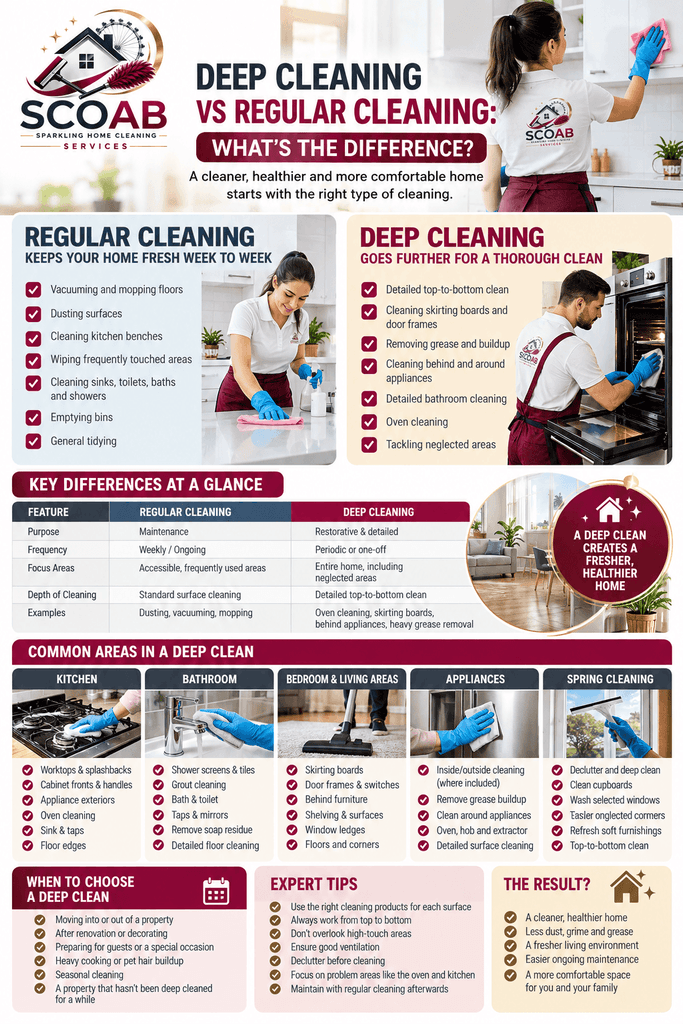
A regular cleaning visit may include:
- Vacuuming and mopping accessible floors
- Dusting commonly used surfaces
- Cleaning kitchen benches
- Wiping tables and frequently touched areas
- Cleaning sinks
- Cleaning toilets, baths and showers
- Emptying bins
- Basic surface cleaning
A deep clean usually involves more detailed work, such as:
- Cleaning skirting boards
- Removing buildup around fixtures
- Cleaning behind and around appliances where accessible
- Degreasing kitchen surfaces
- Detailed bathroom cleaning
- Cleaning doors, handles and frames
- Removing accumulated dust from less-accessible areas
- Detailed floor cleaning
- Cleaning inside selected appliances where requested
- Tackling stubborn marks and residue
The distinction is not simply that a cleaner spends more time in the property. The cleaning process itself is more comprehensive.
Deep Cleaning: What Does It Actually Include?
A useful deep clean should follow a logical system rather than simply spending extra time wiping surfaces.
Experienced cleaners typically work methodically from one area to another, identifying both visible dirt and neglected areas.
A Detailed Top-to-Bottom Clean
A detailed top-to-bottom clean helps prevent dust and debris from being moved onto surfaces that have already been cleaned.
For example, if high-level dust is removed after the furniture has been wiped, particles can settle back onto those surfaces. Working from higher areas downwards is therefore more efficient.
Depending on the property, this may include:
- High-level dusting
- Light fittings and accessible fixtures
- Corners and edges
- Walls and doors where appropriate
- Skirting boards
- Furniture surfaces
- Shelving
- Floors
- Hard-to-reach areas
The exact scope should always depend on the condition and materials within the property. Delicate surfaces, painted finishes and certain flooring types require appropriate cleaning methods rather than aggressive scrubbing.
House Cleaning: Where Regular Cleaning Usually Ends
Routine House Cleaning is important because it prevents dirt from becoming heavily embedded in the first place.
Consider a family home with two adults, two children and a dog. If the floors are vacuumed regularly, kitchen surfaces are wiped after meals and bathrooms are maintained each week, the home may remain in good condition without needing intensive cleaning every few days.
Regular cleaning is particularly useful for controlling:
- Everyday dust
- Food crumbs
- Pet hair
- Surface marks
- Bathroom moisture
- Light soap residue
- General household debris
However, routine cleaning usually focuses on maintaining accessible and frequently used areas.
It may not include detailed work such as cleaning behind appliances, removing heavy grease from an oven or spending significant time on accumulated grime around fixtures.
That is where a deep clean becomes useful.
When Does a Home Actually Need Deep Cleaning?
There is no universal schedule that says every household needs a deep clean every three months.
The right timing depends on lifestyle, occupancy, property condition and how consistently regular cleaning is carried out.
You may consider a deep clean when:
- You have recently moved into a property.
- You are preparing to move out.
- A rental property needs detailed cleaning.
- The home has not been professionally cleaned for an extended period.
- Heavy cooking has caused grease buildup.
- Pets have contributed to hair and odour buildup.
- Dust has accumulated in neglected areas.
- You are preparing for guests or a special occasion.
- You are recovering from renovation or decorating work.
- Seasonal cleaning has been postponed for several months.
For example, someone who cleans their home thoroughly every week may need a major deep clean less frequently than a busy household that only has time for basic maintenance.
Spring Cleaning: Why It Is Often More Detailed
Spring Cleaning is a good example of cleaning that sits somewhere between routine maintenance and a full deep clean.
The traditional idea of spring cleaning involves tackling areas that are not usually included in weekly cleaning.
This might mean:
- Cleaning cupboards
- Decluttering storage spaces
- Washing selected windows
- Cleaning behind furniture
- Dusting neglected corners
- Cleaning skirting boards
- Refreshing soft furnishings
- Cleaning kitchen appliances
- Reviewing areas that have gradually accumulated clutter or grime
Spring cleaning can be approached as a structured deep-cleaning project rather than simply adding more tasks to a normal cleaning day.
One practical approach is to divide the property into zones. Instead of attempting everything at once, work through the kitchen, bathrooms, bedrooms, living areas and utility spaces systematically.
Deep Clean Checklist: A Practical Starting Point
A deep clean checklist helps prevent the common problem of cleaning whatever looks dirty first and forgetting less obvious areas.
Kitchen
A kitchen often needs more detailed attention because cooking produces grease, steam and food residue.
A thorough kitchen clean may involve:
- Worktops
- Splashbacks
- Cabinet fronts
- Cabinet handles
- Sink and taps
- Hob
- Extractor hood surfaces
- Appliance exteriors
- Floor edges
- Skirting boards
- Areas around appliances
- Backsplashes
- Accessible cupboard interiors when requested
Oven Cleaning
Oven cleaning deserves particular attention because ordinary surface wiping does not necessarily remove baked-on grease.
An oven can accumulate carbonised food residue and grease over time. Depending on the oven design and manufacturer’s recommendations, different components may need different cleaning methods.
Before cleaning an oven, it is sensible to check:
- Which components are removable
- Which surfaces should not be treated with certain chemicals
- Whether the manufacturer’s instructions specify cleaning restrictions
- Whether the glass door requires separate attention
Aggressive scraping or unsuitable chemicals can damage certain finishes, so more cleaning is not always better cleaning.
Bathroom
A detailed bathroom clean may address:
- Shower screens
- Tiles
- Grout lines
- Bath surfaces
- Toilet exterior and surrounding areas
- Basins
- Taps
- Mirrors
- Cabinet fronts
- Floor edges
- Soap residue
- Mineral buildup where appropriate
Hard-water deposits can be particularly noticeable around taps and shower areas. These deposits may require an appropriate descaling approach rather than ordinary multipurpose cleaner.
Bedrooms and Living Areas
In living spaces, deep cleaning may include:
- Skirting boards
- Door frames
- Light switches
- Accessible areas behind furniture
- Shelving
- Window ledges
- Corners
- Upholstery surfaces where included
- Floors and edges
The objective is to address areas that routine cleaning often passes over.
When a One-Off Deep Clean Makes More Sense
A one-off deep clean Milton Keynes service can be useful when you do not need ongoing professional cleaning but want the property brought back to a more manageable baseline.
This is particularly relevant after:
- Moving house
- Hosting a major event
- Long periods of limited cleaning
- Renovation work
- A change in occupants
- Extended travel
- Illness or other disruption to normal household routines
- Preparing a property for sale or rental
Imagine moving into a property where the previous occupants maintained it reasonably well but rarely cleaned inside cupboards, around appliance edges or in certain bathroom areas.
A regular clean may maintain the property, but starting with a detailed one-off clean can create a cleaner baseline. After that, routine cleaning becomes much easier to manage.
Kitchen Deep Cleaning Service MK: Why Kitchens Need Special Attention
The kitchen is one of the clearest examples of why deep cleaning differs from routine cleaning.
Cooking creates a combination of grease, heat, moisture and food particles. These can gradually settle on surfaces and become harder to remove.
A kitchen deep cleaning service MK may therefore involve more detailed attention to areas such as:
- Cooker and hob surfaces
- Oven
- Extractor area
- Splashbacks
- Cabinet doors
- Handles
- Worktops
- Sink
- Taps
- Appliance exteriors
- Floor edges
One common mistake is to focus only on visible surfaces. Grease can also collect around handles, the sides of appliances and areas immediately adjacent to cooking zones.
For households that cook frequently, regular maintenance remains important even after a deep clean. Otherwise, the same buildup will gradually return.
Professional Cleaning: When Is It Worth It?
Professional Cleaning can be particularly useful when the required work is more detailed than the time or equipment available to a household.
There is also a practical difference between knowing that an area needs cleaning and having the right process to clean it safely.
For example, different surfaces may require different products and techniques. Natural stone, stainless steel, painted surfaces, glass, timber and certain flooring materials should not automatically be treated with the same chemical.
A professional approach should therefore involve more than simply using a stronger cleaning product.
It should consider:
- The material being cleaned.
- The type of dirt or buildup.
- The appropriate cleaning method.
- Whether the surface can tolerate moisture or chemicals.
- The safest way to complete the task without causing damage.
That level of consideration is one reason professional cleaning can be useful for demanding jobs.
Affordable Deep Cleaning Milton Keynes: Does Cheaper Always Mean Better?
People naturally want cleaning to be affordable, but the lowest quoted price does not necessarily represent the best value.
When comparing affordable deep cleaning Milton Keynes options, look beyond the headline price.
Ask what is actually included.
For example, two cleaning quotes may appear similar, but one may include detailed kitchen work, bathroom descaling and skirting-board cleaning while another only covers standard surface cleaning.
Useful questions include:
- What areas are included?
- Is oven cleaning included?
- Are internal cupboards included?
- Is the cleaning based on property size or condition?
- Are there additional charges for particularly heavy buildup?
- Are cleaning products and equipment supplied?
- What happens if a particular surface requires specialist treatment?
A transparent scope of work is often more useful than simply choosing the cheapest quote.
Deep Cleaning vs Regular Cleaning: A Simple Comparison
| Cleaning Task | Regular Cleaning | Deep Cleaning |
| Vacuuming floors | Usually | Yes |
| Mopping | Usually | Yes |
| Surface dusting | Yes | Yes, more detailed |
| Kitchen worktops | Yes | Yes |
| Bathroom surfaces | Yes | Yes, with more detailed attention |
| Skirting boards | Sometimes | Commonly included |
| Door frames | Limited | More detailed |
| Appliance exteriors | Sometimes | Usually more detailed |
| Oven | Usually separate or limited | Often included if requested |
| Behind/around appliances | Limited | More likely to be addressed |
| Heavy grease buildup | Limited | Targeted treatment |
| Neglected corners | Limited | Yes |
| One-off restorative cleaning | No | Yes |
The exact scope varies between cleaning providers, so it is important to confirm inclusions before booking.
Common Deep Cleaning Mistakes to Avoid
Trying to Clean Everything With One Product
A multipurpose cleaner may be suitable for some surfaces but inappropriate for others.
Using the wrong product can cause:
- Streaking
- Discolouration
- Surface damage
- Residue
- Deterioration of finishes
Always consider the material before choosing a cleaning solution.
Assuming Deep Cleaning Means Sterilising Everything
Deep cleaning is not the same as medical-grade sterilisation.
A thorough household clean removes dirt, grease, dust and other contaminants from surfaces, but ordinary domestic cleaning should not be presented as equivalent to specialised infection-control procedures.
Ignoring Ventilation
Cleaning products can produce fumes, particularly in enclosed bathrooms and kitchens.
Good ventilation is important when using cleaning chemicals. Follow product instructions and avoid mixing cleaning products.
Forgetting the High-Touch Areas
Door handles, light switches, cupboard handles and frequently touched surfaces can be overlooked because they are small.
A detailed clean should consider how people actually use the home, not just what looks dirty.
Spending Too Much Time on Already-Clean Areas
Another common mistake is repeatedly cleaning visible surfaces while ignoring neglected areas.
If the kitchen worktop is already clean but the sides of the cooker have accumulated grease, the second area may benefit more from attention.
Deep cleaning is about prioritisation.
How to Prepare for a Deep Clean
You can make a professional deep clean more effective by doing a little preparation beforehand.
Declutter First
Cleaning around piles of belongings takes longer and makes it harder to reach surfaces.
Move loose items from floors, benches and other areas where practical.
Identify Priority Areas
If the property has particular problem areas, point them out beforehand.
For example:
- Heavy kitchen grease
- Bathroom scale
- Pet-hair accumulation
- Neglected cupboards
- High-dust areas
- Oven buildup
This helps the cleaner understand where detailed work may be most valuable.
Separate Cleaning From Repairs
Cleaning can improve the appearance of a property, but it cannot fix damaged materials.
For example, cleaning may remove surface dirt from grout, but it cannot necessarily repair cracked grout. Likewise, cleaning can improve a stained surface without being able to reverse permanent material damage.
Having realistic expectations makes the process much smoother.
Expert Tips for Keeping a Deep-Cleaned Home Fresh
Once a property has received a thorough clean, regular maintenance becomes much easier.
A practical routine could include:
Daily:
Deal with spills, food residue and obvious mess as soon as possible.
Weekly:
Vacuum, mop, clean bathrooms and wipe kitchen surfaces thoroughly.
Monthly:
Pay attention to areas such as skirting boards, appliance edges, cupboard fronts and less frequently used spaces.
Seasonally:
Review areas that have gradually accumulated dust, clutter or buildup.
As needed:
Arrange a deeper clean when the property condition demands more than normal maintenance.
This approach is usually more practical than waiting until the entire home becomes difficult to manage.
Conclusion: Choosing the Right Level of Cleaning
The difference between regular cleaning and deep cleaning comes down to purpose.
Regular cleaning keeps everyday dirt under control. Deep cleaning addresses accumulated dirt and neglected areas that routine cleaning does not always reach.
For households in Milton Keynes, deep cleaning services Milton Keynes can be particularly useful when a property needs a more comprehensive reset, whether that is before moving, after a period of limited cleaning, during seasonal maintenance or simply when certain areas have become difficult to manage.
A one-off deep clean can establish a cleaner starting point, while regular cleaning can help maintain that condition. The most practical approach is not necessarily to deep clean everything constantly. It is to understand what your home needs, prioritise the areas that require genuine attention and maintain them consistently afterwards.
If you are comparing affordable deep cleaning Milton Keynes options, look carefully at the scope of work rather than price alone. A clear checklist, realistic expectations and appropriate cleaning methods are far more useful than a vague promise of a “deep clean.”
Ultimately, good cleaning is not about making a property look temporarily spotless. It is about removing accumulated dirt thoughtfully, caring for different surfaces properly and creating a home that is easier to maintain over time.
FAQs About Deep Cleaning
1. How often should a home receive a deep clean?
There is no single schedule that works for every household. A low-occupancy home that receives consistent weekly cleaning may only need a deep clean occasionally. Homes with children, pets, frequent cooking or heavy foot traffic may benefit from more frequent detailed cleaning.
A better indicator is property condition. If neglected areas are becoming visibly dusty, greasy or difficult to maintain during routine cleaning, it may be time for a deeper clean.
2. Is deep cleaning the same as spring cleaning?
Not exactly. Spring cleaning is often a seasonal household cleaning project that includes tasks outside the normal routine. Deep cleaning is a broader cleaning approach that can be carried out at any time of year.
There is significant overlap between the two. For example, cleaning skirting boards, appliance areas, cupboards and neglected corners could form part of either a spring-cleaning project or a professional deep clean.
3. Does deep cleaning include oven cleaning?
It depends on the cleaning service and the agreed scope. Oven cleaning is often treated as a separate or additional task because it can require more time and specific methods.
If oven cleaning is important to you, confirm this before booking rather than assuming it is automatically included in a standard deep-cleaning package.
4. Should I deep clean before moving into a new home?
It can be useful, particularly if you want to establish a clean baseline before unpacking everything.
An empty property is often easier to clean because furniture and belongings are not blocking floors, corners and surfaces. Cleaning before moving boxes and furniture into the home can therefore make certain areas much easier to access.
5. Can regular cleaning replace deep cleaning?
Regular cleaning can reduce the need for frequent deep cleaning, but it does not always replace it. Routine cleaning is primarily about maintenance. Some areas naturally receive less attention because they are difficult to access or require additional time. A periodic deep clean can address those areas and then make ongoing maintenance easier.

